Open source · AGPL-3.0
Build upon what's possible
HackUpon is the innovation program platform for businesses, universities and enterprises. Design challenges, bring people together, form teams around ideas, build, demo and evaluate — from a weekend hackathon to a year-long program — and keep what everybody built, for the sponsors behind it too.
Open source on January 1, 2027
The code goes public on release day. Count down with us and get an email when it’s out.
Get the release emailHackUpon goes open source on January 1, 2027.
It’s out. See the code on GitHub
The Open Innovation Collective
AI is changing who can build software. Open source can help determine who benefits.
HackUpon is the first flagship project of the Open Innovation Collective: open-source maintainers, AI practitioners, developers, educators and entrepreneurs shaping how software engineering evolves in the age of AI.
Ready on day one
Most of a program's work is designing it well and keeping it moving. HackUpon starts you with both.
-
18 AI agents
From designing the event to briefing the judges and chasing what comes after, each one proposes and a person decides. Meet the agents
-
86 event templates
An AI hackathon with discovery pre-work, a design sprint, an account clinic: the phases, questions and rubrics already in place. See the templates
-
33 programs, 84 challenge briefs
Events strung into a season, and problems ready to set, from answering questions from your own documents to payments that work offline. Browse the library
For your industry
Starter packs written the way each industry innovates: its own event templates, programs, challenge briefs and innovation areas. See every industry
-
Defense and security
Problem framing with end users, gated competitions on readiness levels, red-team weeks and field trials. See the defense and security pack
-
Manufacturing
A shop-floor problem hunt, an industrial AI hackathon on plant data and a line pilot measured against a baseline. See the manufacturing pack
-
Finance and banking
A RegTech sprint, an open banking hackathon on sandbox APIs and a model risk review before anything reaches a customer. See the finance and banking pack
-
Public sector
A front-line problem hunt, a digital service alpha and challenge-based procurement. See the public sector pack
-
Healthcare
Clinical problem discovery, a health hackathon on synthetic data and a clinical evaluation with a safety case. See the healthcare pack
-
Education
Teaching problem discovery, a learning hackathon on anonymized data and a classroom pilot for a term. See the education pack
-
Energy and utilities
An operations problem hunt, a grid data hackathon on historical data and a field trial with a safety case. See the energy and utilities pack
-
Life sciences
Research problem discovery, a lab data hackathon on public data and a validated pilot under change control. See the life sciences pack
-
Telecommunications
A network problem hunt, a network API hackathon in a sandbox and a network trial with a way back. See the telecommunications pack
-
Logistics and transport
A depot problem hunt, a routing hackathon on historical orders and a depot pilot with a safety review. See the logistics and transport pack
-
Nonprofit and social impact
A policy and service lab, a community health outreach sprint, a local climate resilience lab and a food security program run for a month. See the nonprofit and social impact pack
Built for everyone around an innovation program
One place for the people who run a program, the people who back it and the people who take part.
-
Innovation teams
Run internal hackathons and open challenges with private and invitation-only events, several venues, roles for every team member and an audit log of who did what.
-
Event organizers
Universities, communities and agencies start from a template, take registrations and applications, and publish results without a spreadsheet in sight.
-
Sponsors
Put your name on a challenge, follow what it produces, and report back on it.
One event, phases that hand on
Most programs lose the thread between stages. In HackUpon a phase's output is the next phase's input, and the challenges stay the same from start to finish.
Discovery hands in use cases
Teams take a challenge and write up a use case: the problem, the data, its sensitivity, where it may live and whether it touches personal data. Comparable side by side, not a pile of essays.
Claim forms read, not retyped
Use caseBuilt on by
Claims Reader Coded demo
The hackathon builds on them
Each team builds a coded demo on a use case, its own or another team's, and credits it. Organizers can hold a use case back.
Discovery
Hands in4 use cases
Each use case becomes an input
Hackathon
Hands in3 coded demos
The same 3 challenges run in both phases.
Judges get a briefing
The Judge Assistant tells every judge what an entry claims, what its material shows and what to ask the team. The judges score.
DocuMind
Granite 3.3 · OpenShift AIClaims sourced answers from Northwind’s own docs, with a model on its own cluster.
To ask the team
- Can we see retrieval work on real tickets?
- Who may see which ticket fields?
Then the pipeline
After the event, each use case moves on to pilot, to production or is stopped, with who decided and why.
1
Use case
3
Coded demo
1
Pilot
1
In production
2
Stopped
Supplier invoices matched to orders
PilotTwelve-week pilot, owned by Finance operations
Challenges people rally around
A challenge is the problem everybody works on. Write your own, start from a brief, or let the Challenge Agent draft one from a business problem.
-
A problem worth solving
A problem statement, the outcomes you want, the constraints, and how entries will be judged.
-
Backed by a sponsor
A sponsor puts its name on a challenge, follows what it produces, and gets the report it is owed.
-
84 ready-made briefs
From “Answer it from our own documents” to “Payments that work offline”, each with skills, entry questions and a rubric.
-
The same challenge in every phase
Discovery and the hackathon work on the same challenges, so a use case and the demo built on it stay together.
From the first call to the last prize
Every step of a program in one place, so nothing falls between tools.
Launch an event in an afternoon
Public, private or invitation-only; in person, online or hybrid across several venues; phases, a schedule, rules participants accept, and check-in on the day.
Northwind AI Challenge 2026
Northwind Labs
- Discovery
- Hackathon
- Judge
- Results
Teams that form around ideas
People post ideas and back the ones they would build, teams start from them, and every team gets a workspace with tasks, channels, files and its own tools: live votes, surveys, figures from a sheet and a session timer. Every revision of an entry is kept.
Runbook Copilot
Builds on DocuMind’s use case
- Ingest the runbooks
- Answers sized for a phone
- Record the demo
Every revision of the entry is kept.
Judging you can stand behind
Rounds with weighted criteria, judges assigned per entry, conflicts declared before anyone scores, and feedback every team reads when the round closes.
DocuMind
Demo judging- Business value · 40% 8.5
- It works · 40% 8
- Ready for production · 20% 6.5
Results people hear about
Publish winners when you choose, announce them in the app, by email and in Slack or Discord, and put them on every site's screen.
Northwind AI Challenge 2026
09:41
London · local time
Hand-in closes in
23
Hours
55
Minutes
29
Seconds
Participants
64
Teams
12
Handed in
9
AI that proposes, never decides
Eighteen agents check entries, brief judges, design events and challenges, draft reports and announcements, and suggest teams. Each one shows its sources, names the model that wrote it, and waits for a person. Meet the agents.
Challenge Agent
Faster incident triage
2 sources consulted
Written by Granite 3.3 · OpenShift AI
From an idea to production
- 1
Set up
Start from one of 86 event templates, then add challenges, prizes, sponsors and venues, and choose who may register.
- 2
Discover
Teams write up use cases against the challenges: the problem, the data, its sensitivity and where it may live.
- 3
Build
Each team builds a coded demo on a use case, its own or another team's, and every entry credits what it builds on.
- 4
Judge and award
Score with a briefing from the Judge Assistant, publish the results and put the winners on every screen.
- 5
Follow through
The pipeline shows every use case on its way from demo to pilot to production, or why it stopped.
HackUpon in numbers
- 3
- languages at launch, with more to follow
- 18
- AI agents, each waiting for a person
- 0
- fees for participants
- 1
- place from the call to the results
See it in the product
Screens from a demo organization, exactly as they look in HackUpon.
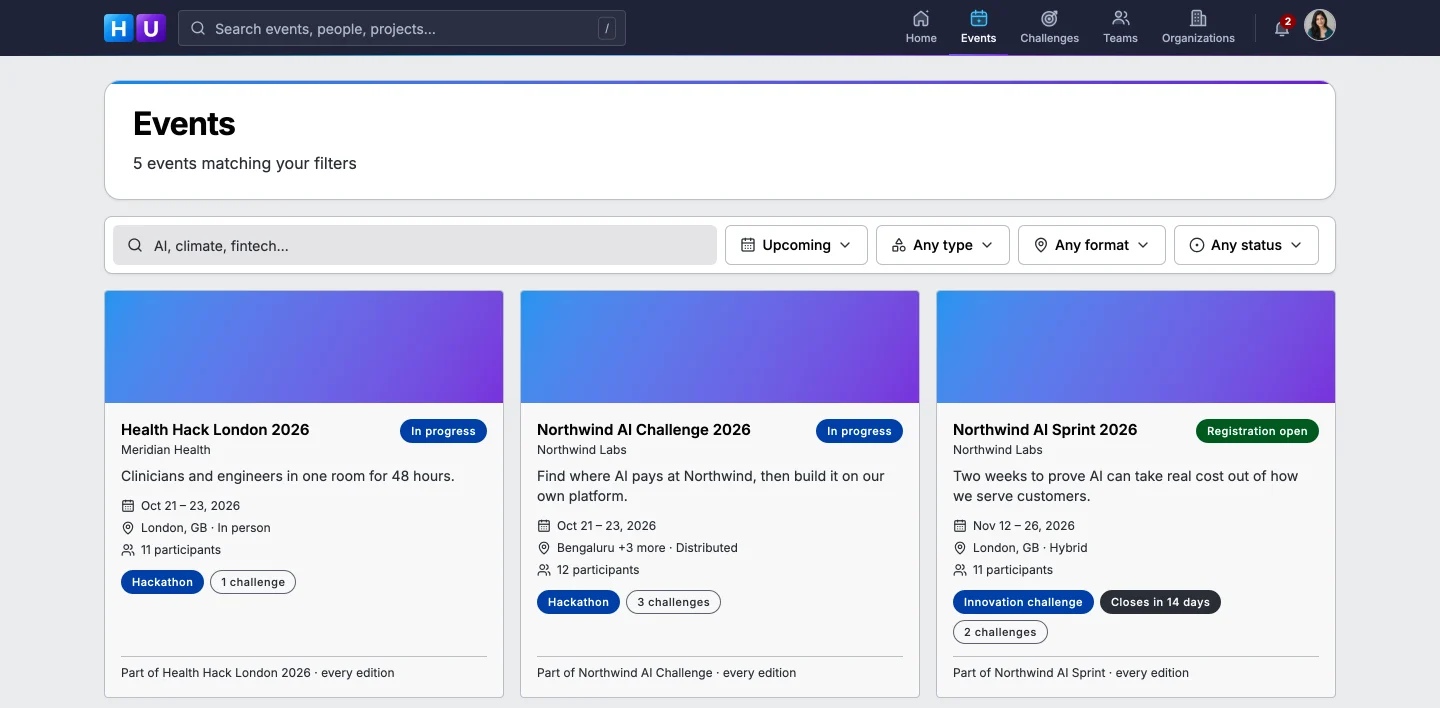
Events Every event on HackUpon, with what is open now.
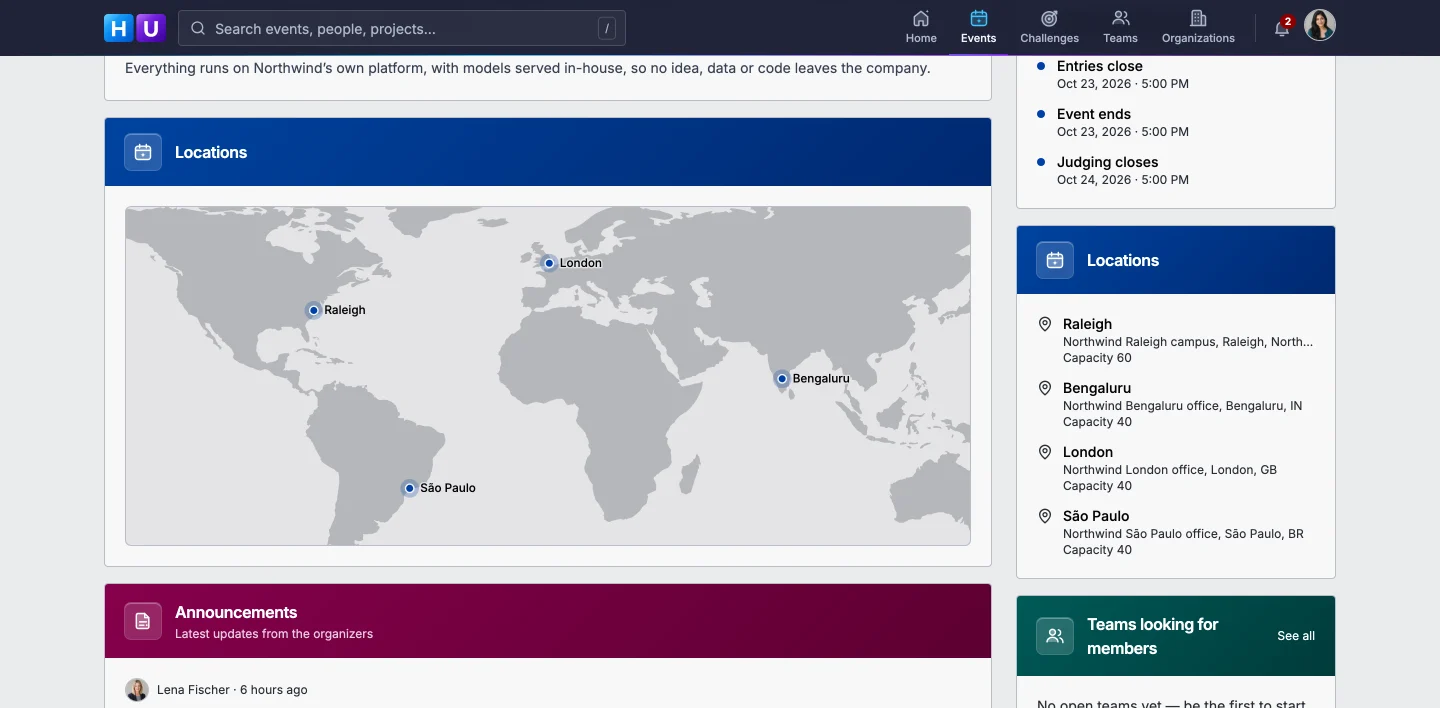
An event Challenges, prizes, sponsors and the schedule on one page.
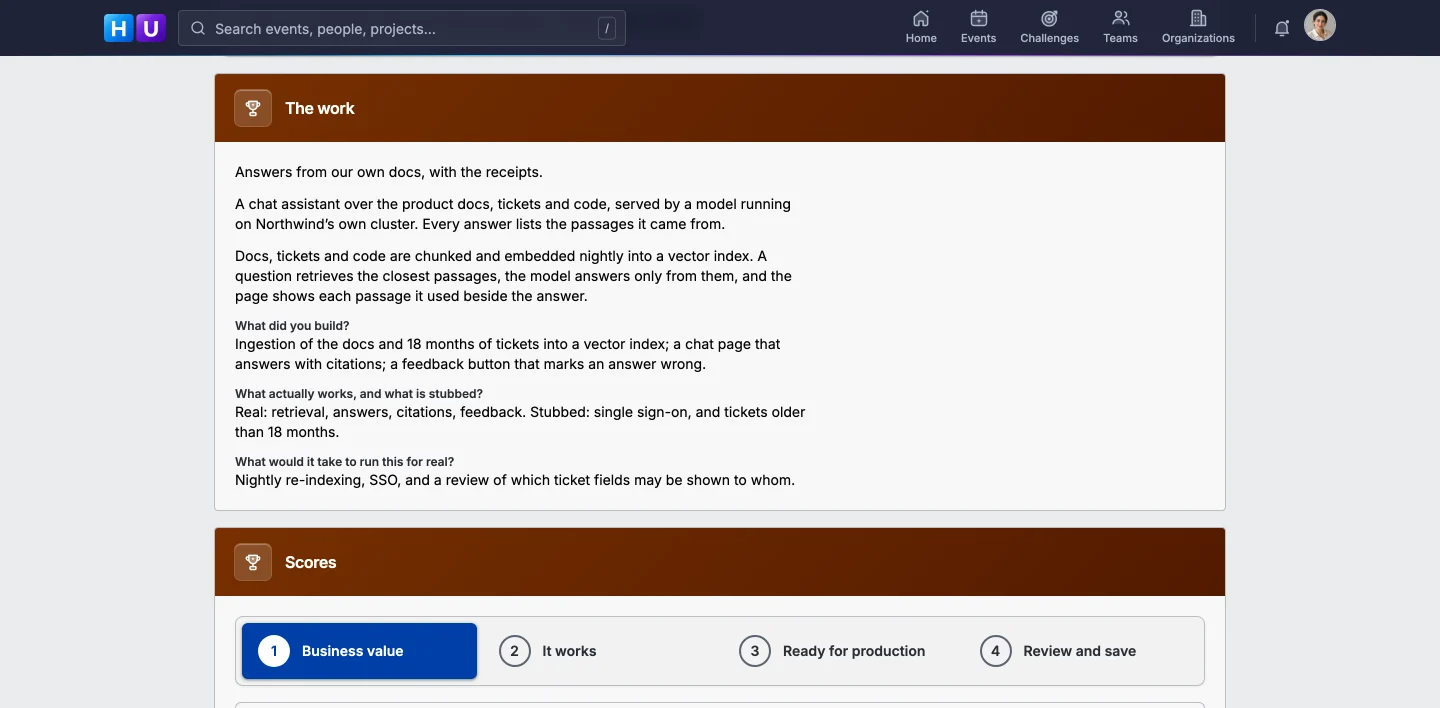
Judging A judge's work list, one entry at a time.
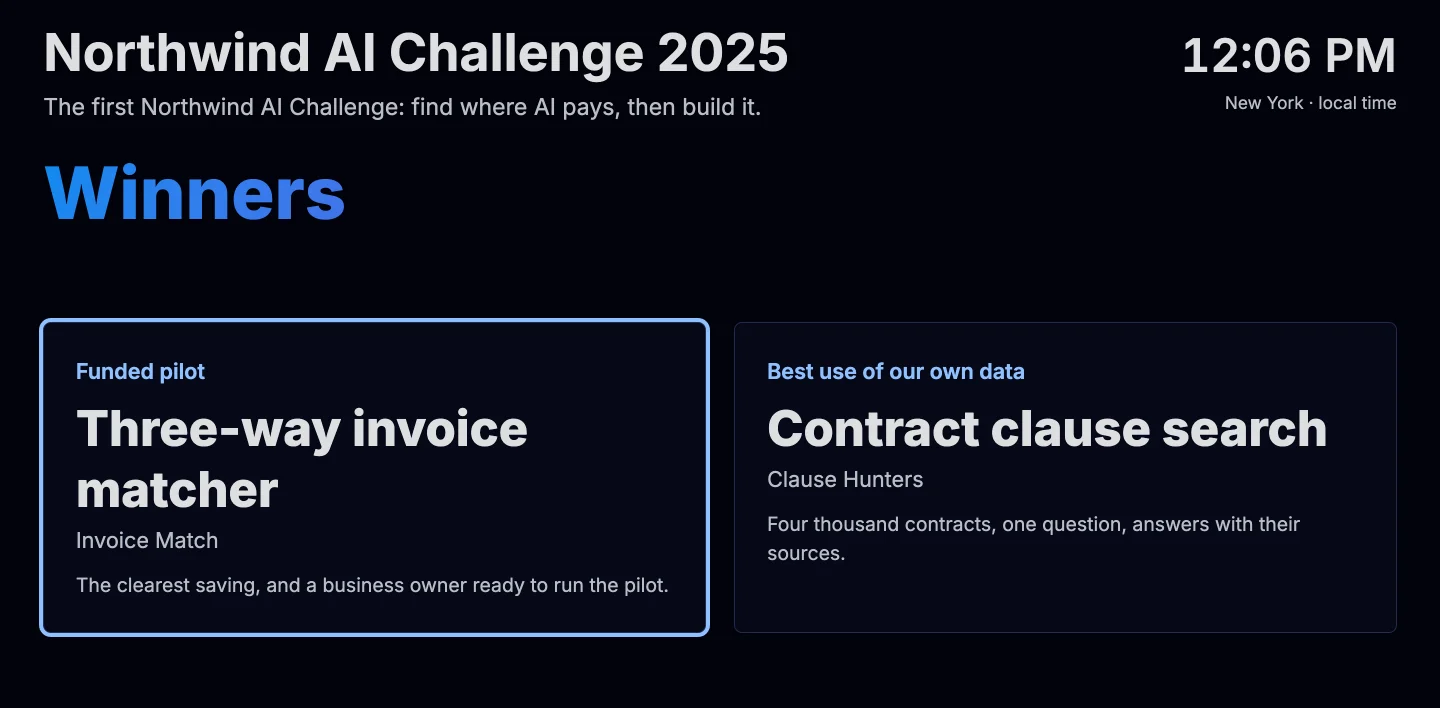
Results Published winners and what they built.
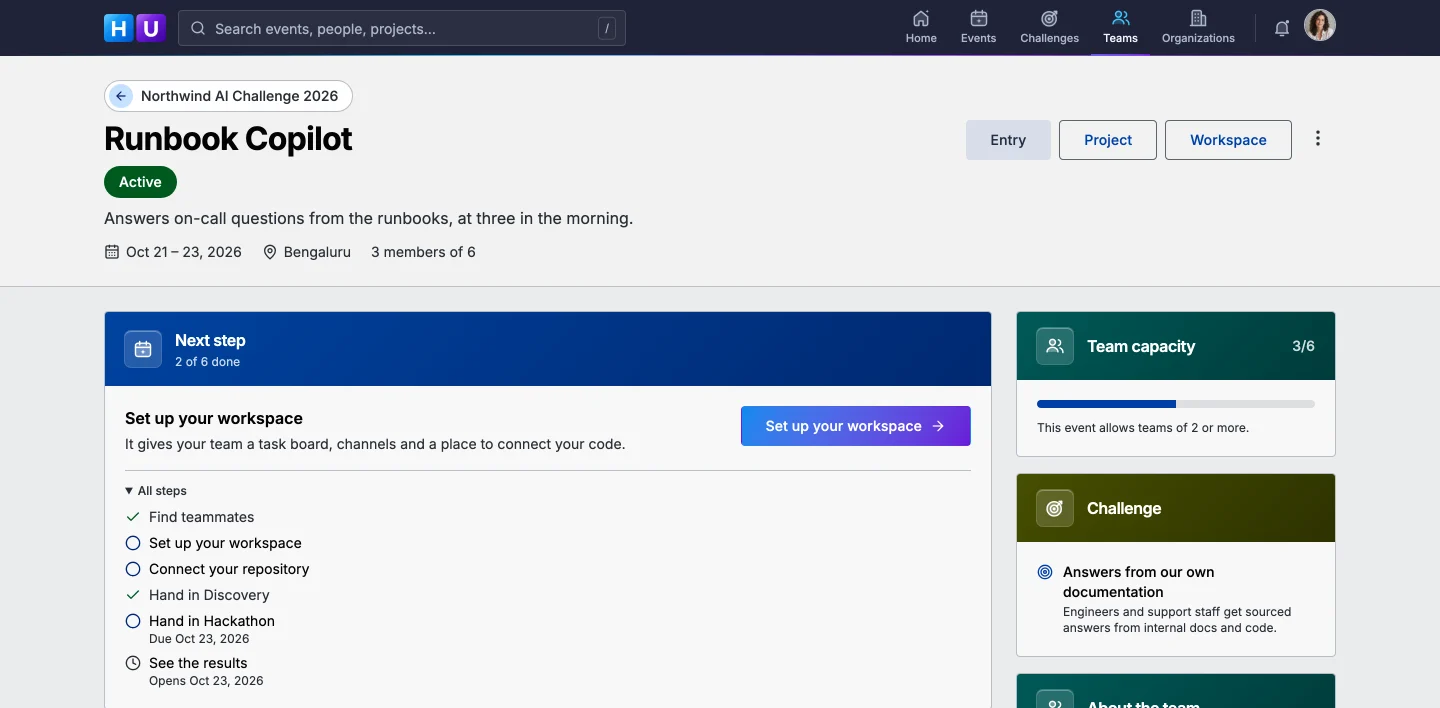
Teams Who is in each team, what it is still looking for, and the room left.
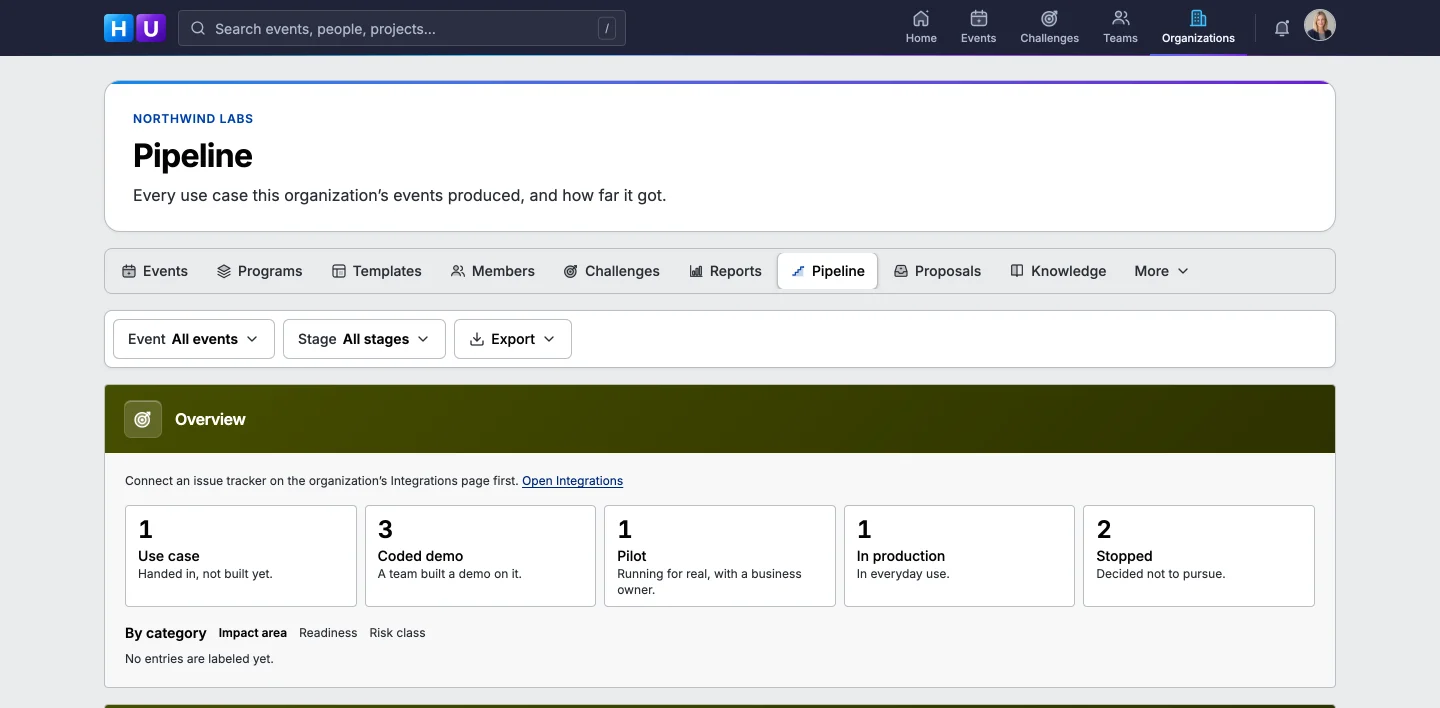
Pipeline Every use case an organization's events produced, and how far it got.
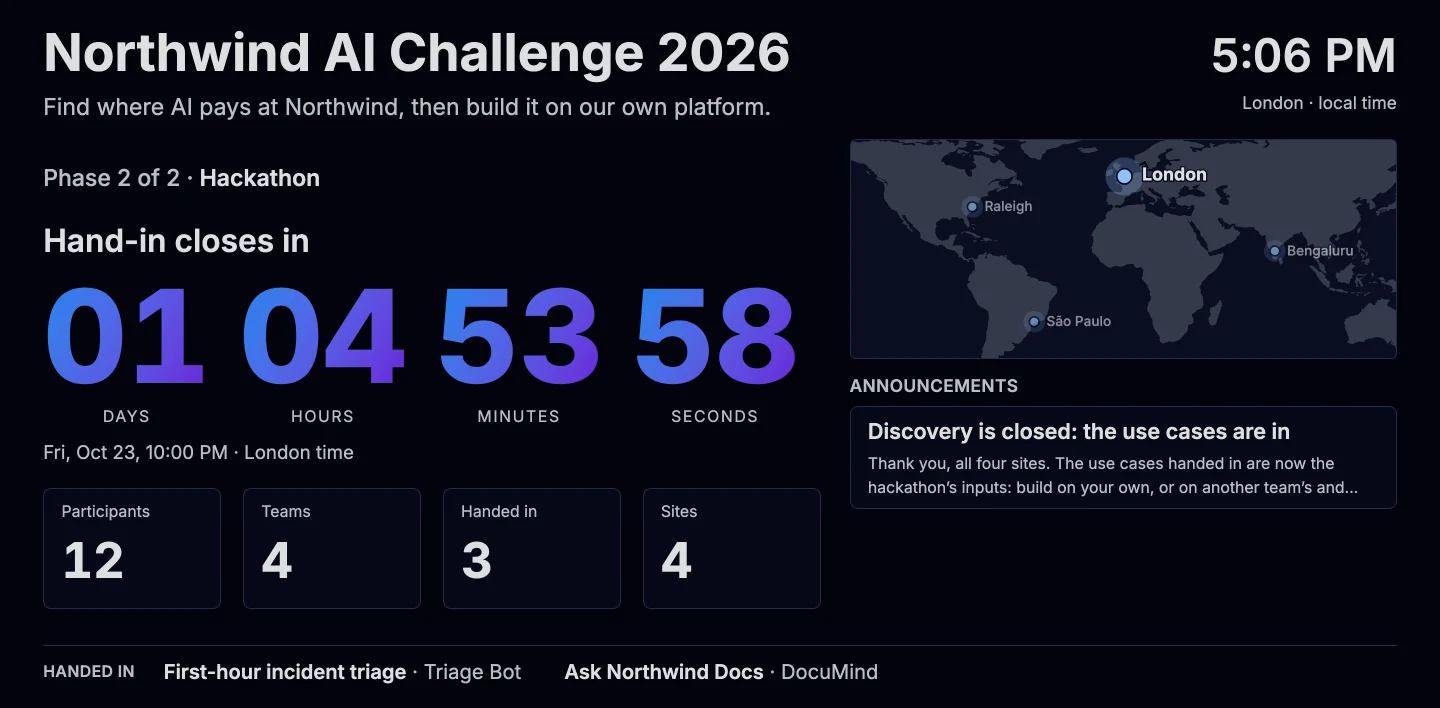
Event wall The projector at each site: the countdown, the map and live counts.
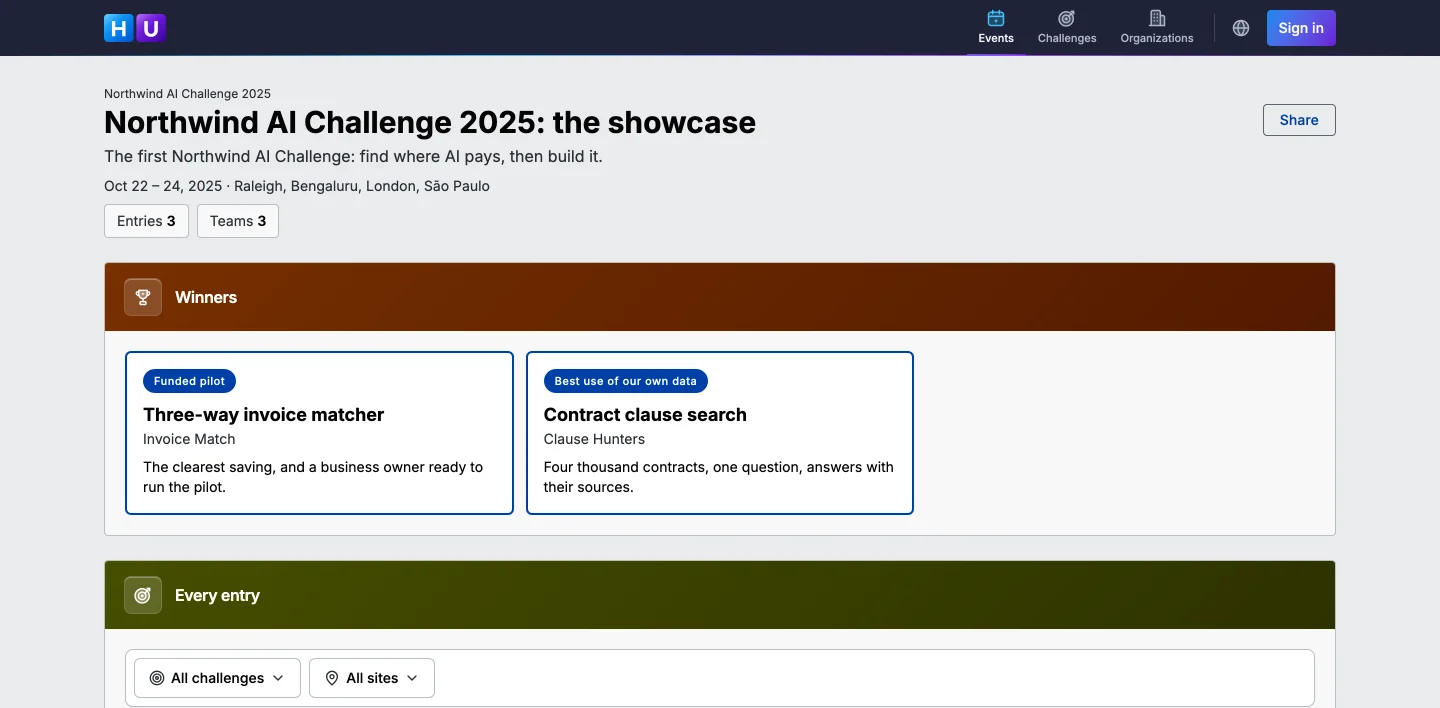
Showcase Accepted entries and winners, published for everyone to share.
Start your next program
Public events and private programs, several venues, campaigns and AI agents on your own model — in one place.